Vitamin D, Depression and Suicide Risk: What the Largest Human Studies Show
On days of remembrance, conversations about loss can feel closer than usual. That makes today a good moment to talk carefully about a subject that is often oversimplified online: vitamin D, depression, self-harm and suicide risk.
The science is more interesting—and more responsible—than a headline claiming that vitamin D “prevents depression” or “prevents suicide.” Some of the largest human studies have found important associations. The largest randomized depression-prevention trial did not show that vitamin D prevented depression. That distinction matters.
What the largest human studies actually found
1. VITAL-DEP: 18,353 adults, randomized, about 5 years
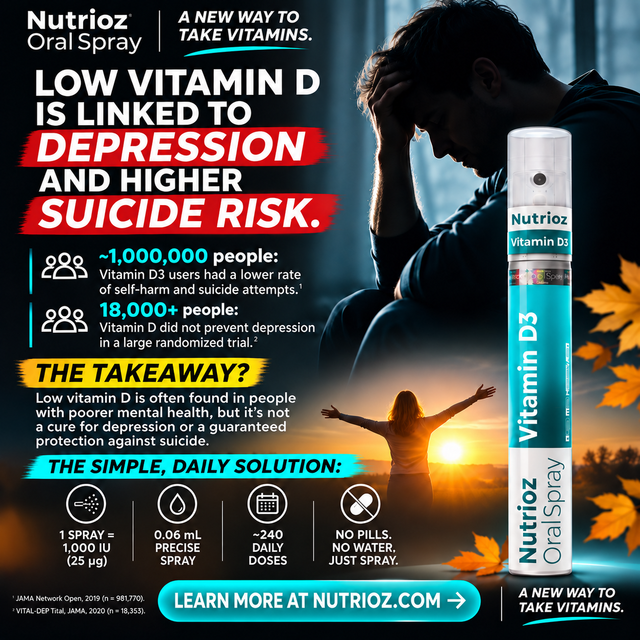
One of the strongest studies because of its randomized design was the VITAL-DEP trial, published in JAMA. It included 18,353 adults aged 50 or older who were assigned to vitamin D3 at 2,000 IU per day or placebo and followed for a median of 5.3 years.
The result was clear: vitamin D3 did not significantly reduce the incidence or recurrence of depression or clinically relevant depressive symptoms. The hazard ratio was 0.97, meaning the two groups were essentially similar for the primary outcome.
Read the VITAL-DEP randomized clinical trial in JAMA →
Why this matters: even a large, long-duration randomized trial does not support claiming that vitamin D supplementation prevents depression in generally healthy older adults.
2. A 2024 meta-analysis: 31 randomized trials, 24,189 participants
A systematic review and dose-response meta-analysis published in 2024 combined 31 randomized trials involving 24,189 participants. Across the full dataset, vitamin D supplementation was associated with a modest reduction in depressive symptoms, with stronger short-term signals among people who already had depressive symptoms.
However, the effects varied substantially by study duration, population and baseline status. Longer trials did not show the same pattern as shorter trials. This is one reason a pooled signal should not be turned into a claim that vitamin D is a treatment for depression.
View the 31-trial meta-analysis on PubMed →
3. The largest suicide/self-harm dataset: nearly 1 million veterans in the D3 analysis
A 2023 PLOS ONE study used U.S. Department of Veterans Affairs data to examine vitamin D supplementation and subsequent suicide attempts or intentional self-harm. In the vitamin D3 analysis, 490,885 supplemented veterans were matched 1:1 with 490,885 untreated controls—981,770 people in total.
Vitamin D3 supplementation was associated with a 44.8% lower risk of suicide attempt or intentional self-harm compared with matched controls. The association was stronger in veterans with low baseline vitamin D levels.
Read the full PLOS ONE study →
But this was not a randomized clinical trial. It was a retrospective observational study. Matching can reduce differences between groups, but it cannot eliminate all confounding. People who receive vitamin D prescriptions may differ from untreated people in ways that affect risk. Therefore, this study cannot prove that vitamin D supplementation caused the lower rate.
4. Military case-control research: low vitamin D and suicide risk
An earlier study examined 495 verified suicide deaths among active-duty U.S. military personnel and compared them with 495 matched controls. People in the lowest range of serum 25-hydroxyvitamin D had the highest observed suicide risk. Participants in the higher vitamin D ranges had roughly half the odds relative to the lowest group.
Read the military case-control study on PubMed →
Again, this is an association. Low vitamin D may coexist with reduced sunlight exposure, illness, less outdoor activity, socioeconomic differences or other factors linked to mental health.
5. Systematic review of vitamin D and suicidal behaviour
A 2023 systematic review identified 11 studies on vitamin D and suicidal behaviours. Seven were included in the meta-analysis, and the pooled findings linked lower vitamin D levels with higher probability of suicidal ideation or attempts. The authors also emphasized that stronger evidence is needed before a causal role can be established.
View the systematic review on PubMed →
So what can we responsibly say?
The evidence supports four careful conclusions:
- Low vitamin D status and depression frequently occur together in observational research.
- Some randomized trials suggest improvements in depressive symptoms, especially in certain populations, but results are inconsistent.
- The largest randomized prevention trial did not show that vitamin D prevents depression.
- Large observational datasets have found lower self-harm and suicide-attempt rates among vitamin D users, but those studies do not prove causation.
That is very different from saying “take vitamin D to prevent suicide.” The current evidence does not justify that claim.
Vitamin D is one variable in a much larger picture
Depression and suicide are complex. Biology matters, but so do trauma, relationships, isolation, chronic illness, substance use, sleep, financial stress, access to care and many other factors. No nutrient should be presented as a substitute for professional mental-health care.
Vitamin D status can still be medically relevant. People at risk of deficiency may benefit from discussing testing, diet, sunlight exposure and supplementation with a qualified healthcare professional. The U.S. National Institutes of Health maintains an evidence-based overview of vitamin D, recommended intakes and safety considerations.
NIH Office of Dietary Supplements: Vitamin D fact sheet →
A note for this day of remembrance
For many families, remembrance days are about people who are no longer with us. Some died after long illnesses. Some died suddenly. Some deaths were connected to mental-health struggles that were never fully visible to others.
Science cannot reduce those lives to a blood test or a supplement. What it can do is help us ask better questions, identify modifiable risk factors and avoid making promises that the evidence does not support.
If today is difficult for you or someone close to you, reaching another person matters more than reading another supplement article. If there is immediate danger, contact local emergency services. In the United States, call or text 988 for the Suicide & Crisis Lifeline.
Nutrioz Vitamin D3: the product facts, without mental-health claims
For people who already use vitamin D as part of their routine and prefer a format without swallowing tablets or capsules, Nutrioz Vitamin D3 Oral Spray provides:
- 1,000 IU / 25 µg vitamin D3 per spray
- 0.06 mL measured spray volume
- approximately 240 sprays in a 14.4 mL tube
- up to approximately 240 one-spray daily doses, when used at one spray per day
- a no-pill, no-water format
Nutrioz calls this measured oral format Molecular Spray Technology®. The name describes the delivery platform; it is not evidence that the product treats depression, prevents self-harm or has superior clinical absorption.
For practical use instructions, see How to Use Nutrioz Vitamin D3 Molecular Spray. For the broader format, see How Molecular Spray Technology® Works.
Nutrioz Vitamin D3 is a dietary supplement. It is not intended to diagnose, treat, cure or prevent depression, suicidal thoughts, self-harm or any other disease.
Sources
- Okereke OI, et al. VITAL-DEP randomized clinical trial. JAMA, 2020.
- Lavigne JE, Gibbons JB. Vitamin D supplementation and suicide attempts/self-harm in U.S. veterans. PLOS ONE, 2023.
- Systematic review and dose-response meta-analysis of randomized vitamin D trials and depressive symptoms, 2024.
- Umhau JC, et al. Low vitamin D status and suicide in active-duty military personnel. PLOS ONE, 2013.
- Systematic review and meta-analysis of vitamin D and suicidal behaviours, 2023.
- NIH Office of Dietary Supplements. Vitamin D Fact Sheet for Health Professionals.