Why do vitamin pills have such poor absorption?
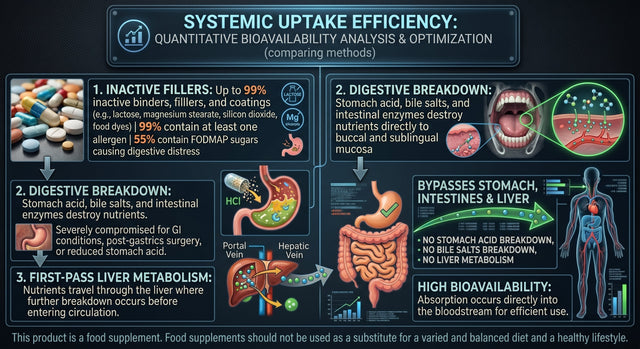
Why do vitamin pills have such poor absorption?
Most people assume that if they swallow a vitamin pill, they absorb the full dose. The reality is very different. Research shows that traditional oral tablets and capsules deliver only 20–40% of their stated nutrient content to the bloodstream.
The three main reasons pills fail
1. Inactive fillers make up most of the pill
Up to 99% of a standard 1-gram vitamin D3 tablet is inactive binders, fillers, and coatings — not the nutrient itself. These include lactose, magnesium stearate, silicon dioxide, and food dyes. Studies show that 93% of oral supplements contain at least one allergen, and 55% contain FODMAP sugars that can cause digestive distress.
2. Digestive breakdown destroys nutrients
Pills must survive stomach acid, bile salts, and intestinal enzymes before absorption can occur. For many people — especially those with GI conditions, post-bariatric surgery, or reduced stomach acid — this process is severely compromised.
3. First-pass liver metabolism
Even nutrients that survive digestion must pass through the liver before entering systemic circulation, where further breakdown occurs.
How does Nutrioz solve this?
Nutrioz uses Molecular Intraoral Delivery (MID) — a 0.06ml micro-spray that delivers nutrients directly to the buccal and sublingual mucosa. Absorption occurs directly into the bloodstream, bypassing the stomach, intestines, and liver entirely. The result: up to 9x higher bioavailability compared to standard tablets.
This product is a food supplement. Food supplements should not be used as a substitute for a varied and balanced diet and a healthy lifestyle.